TL;DR — Attention sinks in LVLMs are neither purely helpful
nor harmful — their effect flips with task and layer,
and a lightweight learned gate can exploit this.
Background
Two kinds of sinks
Large vision–language models concentrate attention on a few sink tokens.
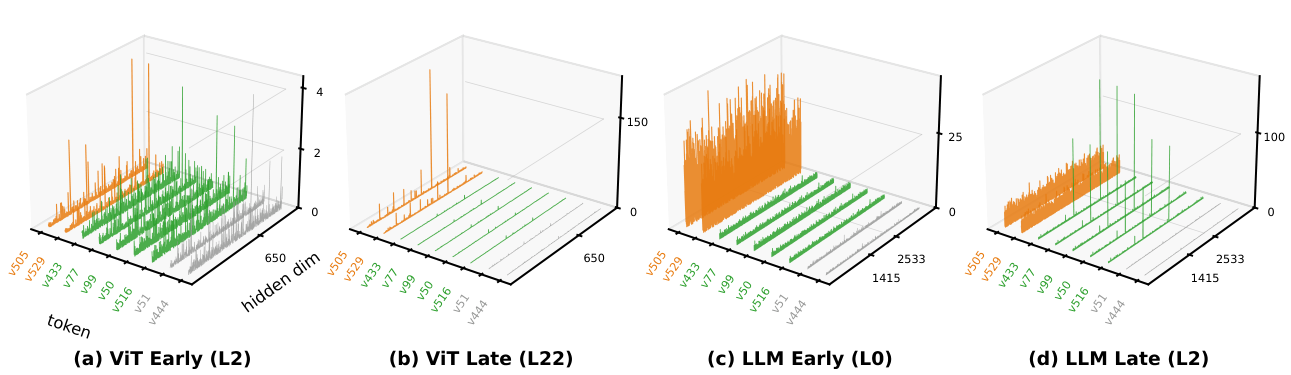
We separate them by origin: V-sinks emerge already inside the vision
encoder and enter the LLM through the projected image tokens, while
L-sinks emerge inside the LLM itself as generation proceeds through
its layers. The two behave differently, and telling them apart is what makes the
rest of the analysis possible.
Paper Fig. 3. Activation patterns of visual tokens across the LVLM
stack: orange = ViT-emerged sinks (V-sinks),
green = LLM-emerged sinks (L-sinks), gray = ordinary tokens.
Massive activations at specific hidden dimensions (650 for CLIP-ViT-L; 1415/2533 for the LLM)
are what identify sink tokens.
The phenomenon
The same intervention helps some tasks and hurts others
We rescale the keys of V-sink tokens by a coefficient
svit at a single LLM layer (pre-softmax, so attention stays a
valid distribution) and measure the accuracy change on ten sub-tasks.
Drag the sliders: some bars go up ▲,
others go down ▼ — at the same layer,
with the same coefficient.
Sub-task
Baseline (%)
Accuracy (%)
Δ (%p)
Precomputed sweep results; not live inference.
LLaVA-1.5-7B, MMStar (6 sub-tasks) + CVBench (4 sub-tasks); the full grid is
32 layers × 11 coefficients, shipped as CSV in the
code repo.
The optimum is broad: in 73% of the 320 layer×task settings the
best and second-best coefficient differ by less than 0.5%p —
what matters is the direction (strengthen vs. suppress), not the exact value.
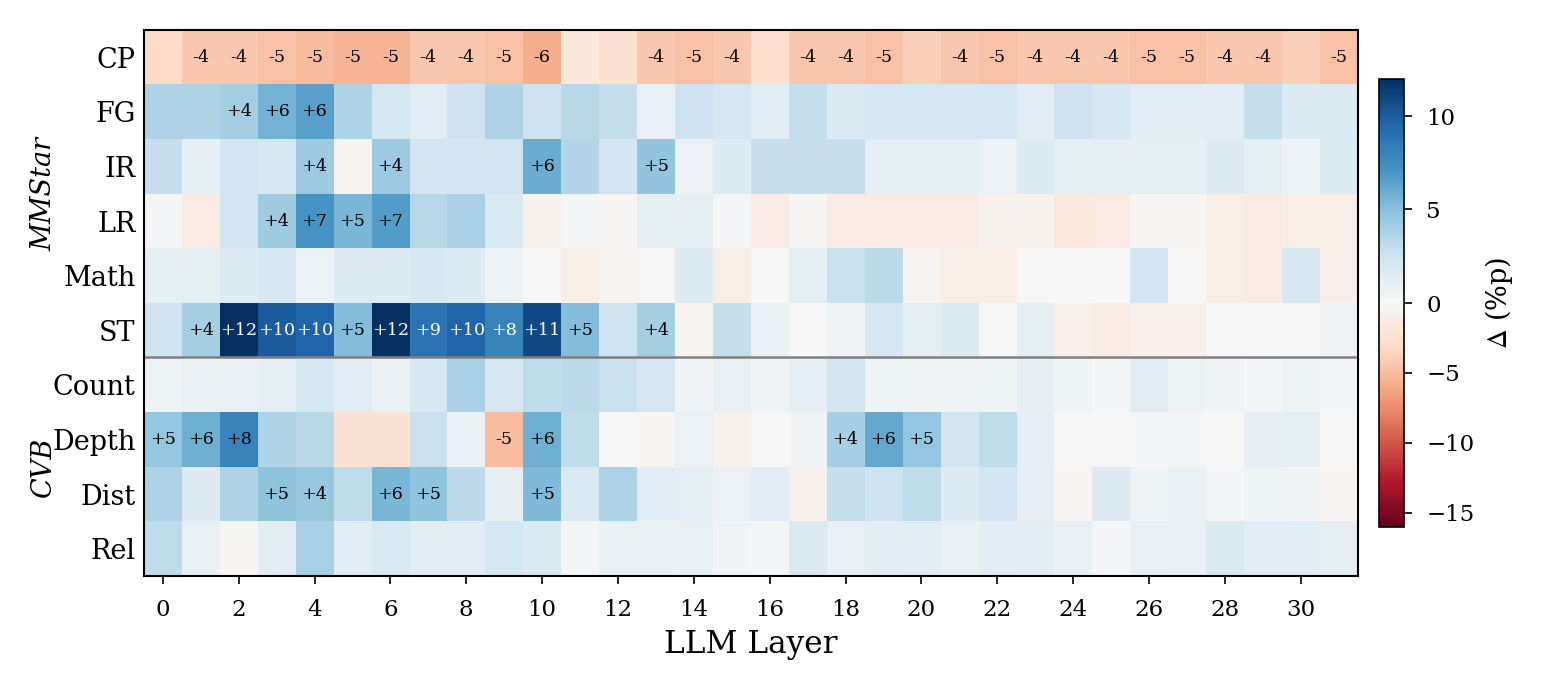
Static counterpart (paper Fig. S4, top). Best-case Δ per (sub-task, layer)
over the 11 coefficients. Early–middle layers show the largest amplitudes in both
directions.
Why
Sink tokens carry global information
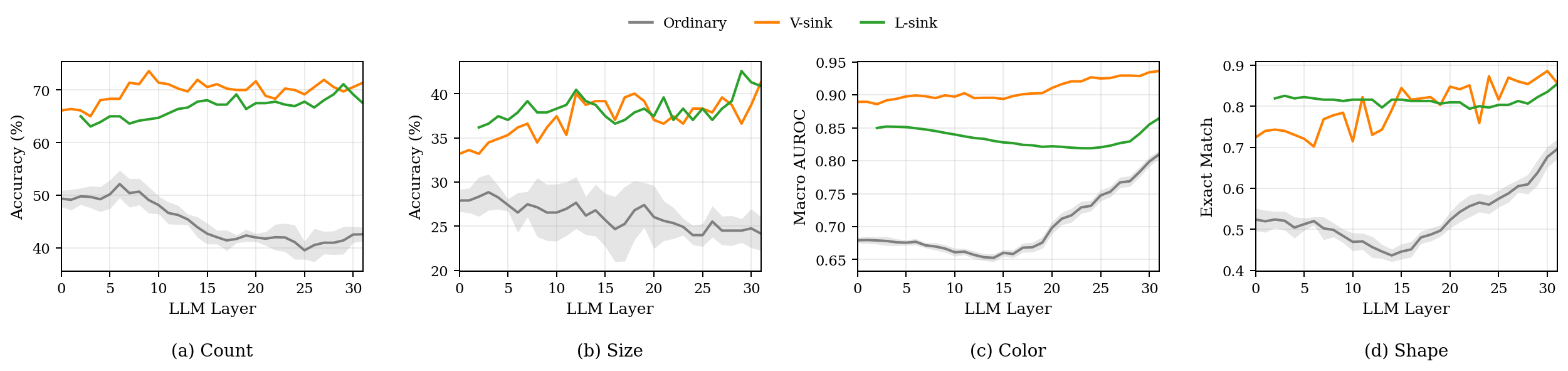
Layer-wise linear probes on CLEVR scene attributes show that both V-sink and
L-sink tokens encode substantially more global scene information (object
counts, sizes, colors, shapes) than ordinary visual tokens at every depth — the
gray band is a 5-seed ±1σ interval over random ordinary-token baselines. Sinks are
not noise to be deleted; they are a channel the model actually uses, which is why
blunt removal can hurt.
Paper Fig. 4. Layer-wise linear probing on CLEVR scene attributes.
Method
Layer-wise Sink Gating (LSG)
If the right amount of sink influence depends on the layer, learn it per layer:
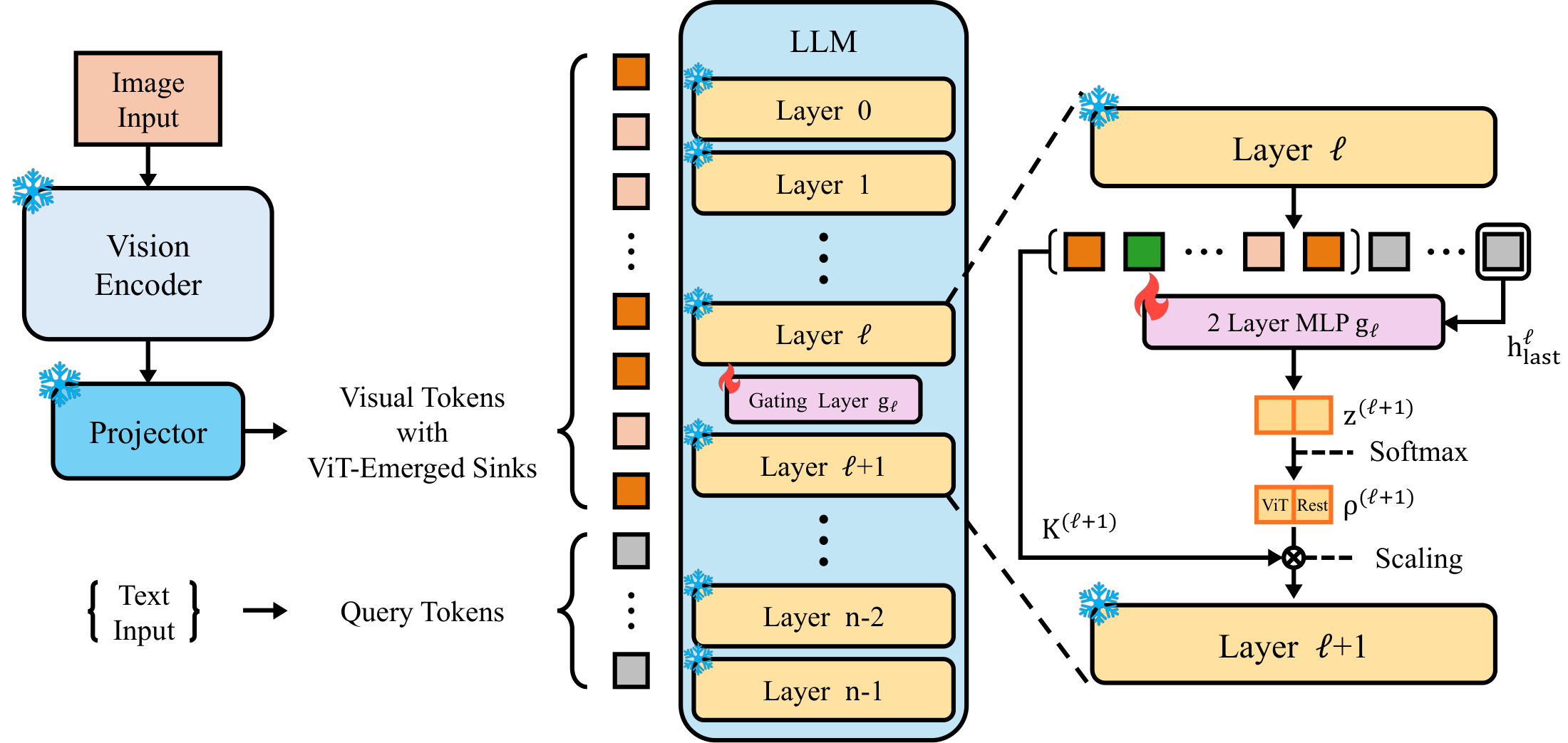
LSG attaches a small MLP to each selected layer that predicts the key-scaling
balance between V-sink tokens and the rest. It is trained with
next-token prediction only — no task labels, and the
backbone stays frozen (each gate is a few hundred KB). Learned gates
land in the same regions the oracle sweep identifies, giving consistent gains
without task supervision.
Paper Fig. 6. A small trainable 2-layer MLP between frozen
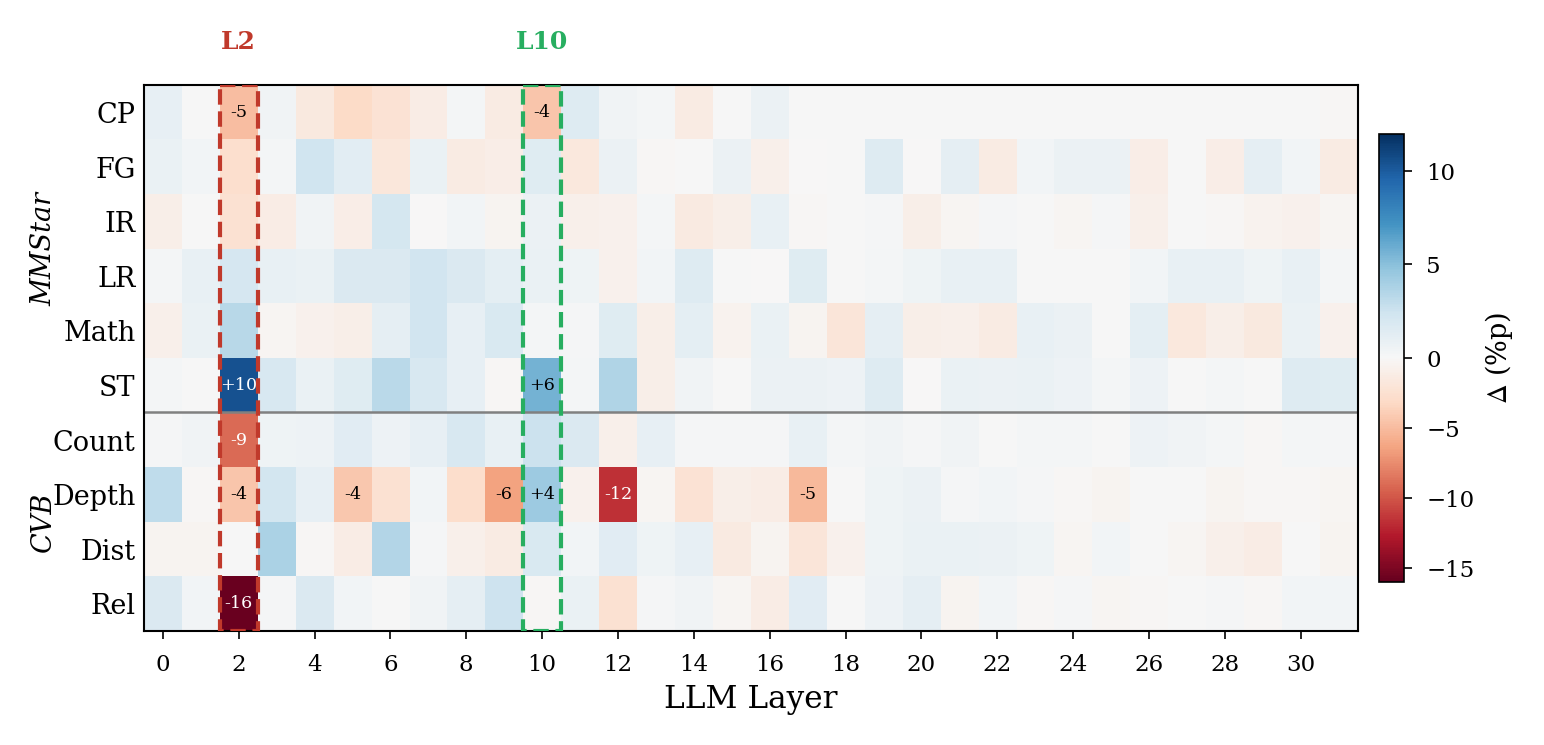
LLM layers predicts the V-sink vs. rest balance and rescales the next layer's keys.Paper Fig. 7. Learned single-layer gate Δ (%p) across all 32 layers
and 10 sub-tasks. Dashed boxes mark L2 (red) and L10 (green).
Generalization
The structure replicates beyond LLaVA-1.5
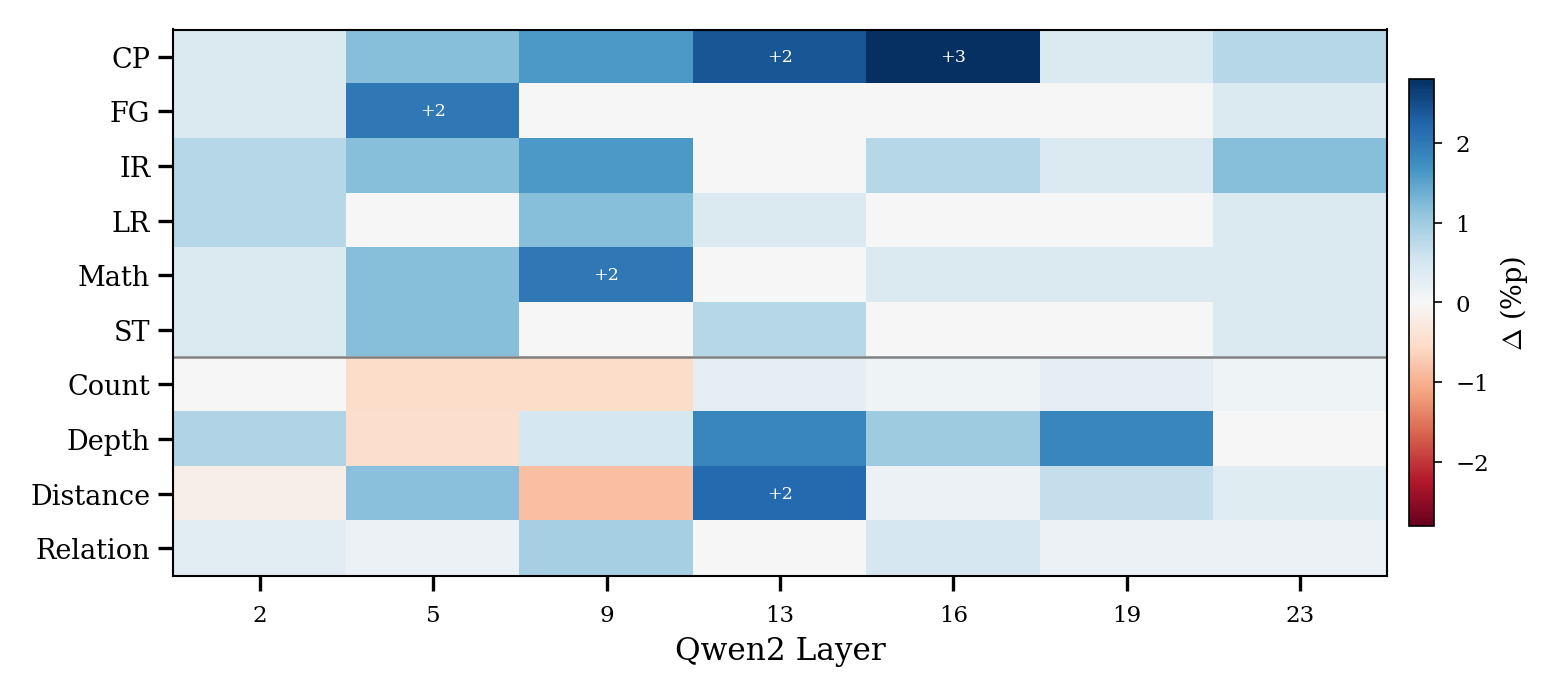
Repeating the taxonomy and the oracle sweep on LLaVA-OneVision-7B
(SigLIP + Qwen2, a different vision encoder and a different LLM) reproduces the
same layer- and task-dependent structure. Further cross-architecture results are
in the paper's appendix.
Paper Fig. S12 (Appendix E). Oracle key-gating sweep on LLaVA-OneVision-7B.
@article{choi2026sinks,
  title={When Sinks Help or Hurt: Unified Framework for Attention Sink in Large Vision-Language Models},
  author={Choi, Jiho and Kim, Jaemin and Kim, Sanghwan and Hong, Seunghoon and Park, Jin-Hwi},
  journal={arXiv preprint arXiv:2604.03316},
  year={2026}
}